* = student co-authors ; ** = community co-authors
SELECTED MONOGRAPHS
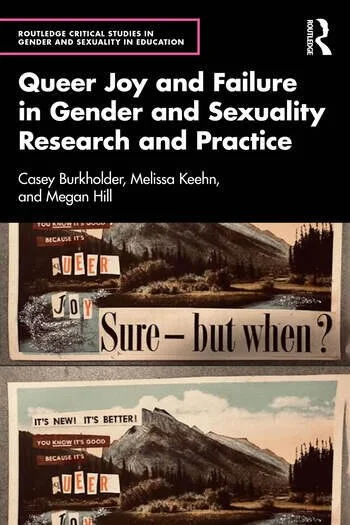
Burkholder, C., Keehn, M. & *Hill, M. (In Press). Queer Joy and Failure in Gender and Sexuality Education. Routledge.
SELECTED PEER REVIEW ARTICLES AND BOOK CHAPTERS
Switzer, S., Sadati, S. M. H., Martin, J., Burkholder, C., Fuentes, K., Ibáñez-Carrasco, F., & Mansfield, E. (2026). From research to creation: The ‘Behind the Scenes’ steps of participatory podcasting for knowledge dissemination. Journal of Participatory Research Methods, 7(2).1-23. https://doi.org/10.35844/001c.162088
Keehn, M., & Burkholder, C. (2026). Exploring Sexuality Education Through Play and Queer Joy with Rural Early Childhood Teachers. Journal of Childhood Studies, 51(3), 65–84. https://doi.org/10.18357/jcs513202621744
Keehn, M. & Burkholder, C. (2026). Don’t say “Lesbian”: Reflections on two sexuality education workshops with teachers in rural New Brunswick. Journal of Qualitative Research. 1-24. https://doi.org/10.1080/09518398.2026.2640849
Thorpe, A., Keehn, M., Orr, C. & Burkholder, C. (2026). Recipe for an L Word rewatch potluck. In A. Ketchum & M. Elias (eds.) Cookout: The 2026 Queer Food Conference Cookbook, 84-85. file:///Users/cburkhol/Downloads/(digital%20PDF)%20Cook%20Out%202%20The%202026%20Queer%20Food%20Conference.pdf
Burkholder, C. & Keehn, M. (2026). “Is it Good or Bad to do Anal?”: Failures in Queer Joy and Sexuality Education. Journal of Curriculum and Pedagogy. 23(1), 68-94. https://doi.org/10.1080/15505170.2024.2427013
Orr, C. E., & Burkholder, C. (2026). Introducing the special issue: on Intersex Joy. Feminist Theory, 27(2). 123-136. https://doi.org/10.1177/14647001251367024
*Dudys, T., Orr, C. & Burkholder, C. (2026). Temporal disobedience: Intersex timescapes, chronopolitics, and queer joy. Feminist Theory. 27(2). 1-23. https://journals.sagepub.com/doi/10.1177/14647001251389818
Breau, C., Burkholder, C. & Orr, C. (2026). Compulsory Dandyism? A Conversation on Intersex Joy and Desire between Dr. Christopher Breu, Dr. Casey Burkholder & Dr. Celeste Orr, Feminist Theory, 27(2). https://journals.sagepub.com/doi/abs/10.1177/14647001251376267
Burkholder, C., Wright, JJ. & Keehn, M. (2025). Queer joy as pedagogy. Teacher’s College Record Teachers College Record: The Voice of Scholarship in Education, 0(0), 1-34. https://doi.org/10.1177/01614681251401633
Burkholder, C., *Hill, M., MacEntee, K., Keehn, M. & **Beaumont, A. (2025). “Dykes on Dollars”: Theorizing femme and other queer futures in a participatory digital archive. Journal of Femininities. 1-27. https://doi.org/10.1163/29501229-bja10026
O’Sullivan, L., Byers, E.S. & Burkholder, C. (2025). How does sexual health education vary in quality of its delivery from the perspective of teachers? The Canadian Journal of Human Sexuality, 34(2), 1-20. https://doi.org/10.3138/cjhs-2025-000
Orr, C. E., & Burkholder, C. (2025). Introducing the special issue: on Intersex Joy. Feminist Theory, 0(0). https://doi.org/10.1177/14647001251367024
Burkholder, C., Whitty, P., Malins, P., & *Keehn, M. (2025). On summoning queer joy in early childhood education: Some findings from New Brunswick, Canada. Journal of Early Childhood Research. 1-17. https://doi.org/10.1177/1476718X251318894
Burkholder, C., Wright, JJ. & **Pride/Swell+. (2024). Queerly and joyfully engaging intergenerational conversations through art to challenge gender-based violence. Studies in Art Education. 65(4), 488–508. https://doi.org/10.1080/00393541.2024.2390780
Wright, JJ. & Burkholder, C. (2024). Introduction to the special issue “Mobilizing queer joy: Establishing queer joy studies.” Sexualities. 1-10. https://journals.sagepub.com/doi/10.1177/13634607241304546
Burkholder, C. & *Keehn, M. (2024). “Is it Good or Bad to do Anal?”: Failures in Queer Joy and Sexuality Education. Journal of Curriculum and Pedagogy. 1-27. https://doi.org/10.1080/15505170.2024.2427013
Switzer, S., Alarcón, A., Gaztambide-Fernández, R., Burkholder, C., *Howley, E. & Carrasco, F. (2024). Online and remote community-engaged facilitation: Pedagogical and ethical considerations and commitments. Journal of Participatory Research Methods. 5(3). 1-31, https://doi.org/10.35844/001c.116337
Burkholder, C., *Keehn, M., MacEntee, K., *Hill, M., **Beaumont, A., & **Hunt, S. (2024). “There’s a lot of DIY joy”: Elevating queer joy through participatory visual research with 2SLGBTQIA+ folks in Atlantic Canada. Journal of Gender Studies, 1–20. https://doi.org/10.1080/09589236.2024.2387192
Burkholder, C. & *Keehn, M. (2024). Mobilizing femme pedagogy in sexuality education in New Brunswick, Canada. Curriculum Inquiry. 1–26. https://doi.org/10.1080/03626784.2024.2360569
Byers, S., O’Sullivan, L. & Burkholder, C. (2024). How Prepared are Teachers to Provide Sexual Health Education? American Journal of Sexuality Education. https://www.tandfonline.com/doi/full/10.1080/15546128.2024.2344518
Burkholder, C. & *Keehn, M. (2024). "In some ways they’re the people who need it the most": Mobilizing queer joy with sex ed teachers in New Brunswick, Canada. Journal of Queer and Trans Studies in Education. 1(2), 1-15. Retrieved from https://scholarscompass.vcu.edu/jqtsie/vol1/iss2/1.
*Keehn, M., Burkholder, C., MacEntee, K., *Hill, M., **Poirer, I. & **Beaumont, A. (2024). Doing it together, but in a queer way: Joyful worldmaking with 2SLGBTQI+ folks in Atlantic Canada. Journal of LGBT Youth. https://doi.org/10.1080/19361653.2024.2302034
*Simon, S. Burkholder, C. & **Pride/Swell. (2024). Resilience and solidarity building on Instagram: Exploring art, activism, and participatory analysis with Indigenous peoples and 2SLGBTQ+ youth in the Wabanaki Confederacy. Exploring the human story: Arts-based approaches to qualitative inquiry in educational studies. Routledge.
Burkholder, C. & Thompson, J. (2024). Teaching fieldnotes. In A. Ruth, A. Wutich & H.R. Bernard (Eds.) The handbook of teaching qualitative and mixed methods research: A step-by-step guide, (pp. 97-101). Routledge. doi: 10.4324/9781003213277-25
Burkholder, C. & *Keehn, M. (2023). “Something that is so overlooked”: Joyfully exploring queer bodies and sexualities in sex education in New Brunswick, Canada through participatory art production. Sex Education. https://doi.org/10.1080/14681811.2023.2296984
Burkholder, C., MacEntee, K., *Thorpe, A & **Pride/Swell. (2023). Solidarity through mail-based participatory visual research: Reflections from an art, activism & archiving project with 2SLGBTQ+ youth amidst COVID-19. Feminist Review. 135(1), 1-22. https://journals.sagepub.com/doi/10.1177/01417789231205297
Burkholder, C., *Hamill, K. & *Thorpe, A. (2023). Speaking back to gender-based violence in New Brunswick schools through queer maker literacies with 2SLGBTQ+ youth. Journal of Youth Studies. DOI: 10.1080/13676261.2023.2246910
Lebel, S, Cruickshank, L. & Burkholder, C. (2022). Pivoting feminist praxis: From a writing collective to pandemic pedagogies. Feminist Pedagogy. 2(1), 1-6, https://digitalcommons.calpoly.edu/feministpedagogy/vol2/iss1/5
Burkholder, C., Aladejebi, F. & Schwab-Cartas, J. (2022). Embracing new paths in visual research facilitation: Opportunities, tensions & ethical considerations, Visual Studies, 37(1-2), 7-10, DOI: 10.1080/1472586X.2021.1962735
Burkholder, C. & *Thorpe, A. (2022). Facilitating gender-affirming participatory visual research in embodied and online spaces. Visual Studies, 37(1-2), 37-46. DOI: 10.1080/1472586X.2021.1982650
Rogers, M. & Burkholder, C. (2022). “I feel like there should have been an opportunity for consultation”: Navigating pandemic education reforms with New Brunswick teachers. Our Schools/ Our Selves: Education in crisis. 9-13. https://www.policyalternatives.ca/publications/ourschools-ourselves
Burkholder, C. & *Thorpe, A. (2021). Facilitating gender-affirming participatory visual research in embodied and online spaces. Visual Studies. DOI: 10.1080/1472586X.2021.1982650
Burkholder, C., MacEntee, K., Mandrona, A., & *Thorpe, A. (2021). Co-producing digital archives with 2SLGBTQ+ Atlantic Canadian youth amidst COVID-19. Qualitative Research Journal. Vol. ahead-of-print No. ahead-of-print. https://doi.org/10.1108/QRJ-01-2021-0003.
Burkholder, C., *Hamill, K. & *Thorpe, A. (2021). Zine production with queer youth and pre-service teachers in New Brunswick, Canada: Exploring connection, divergences and visual practices. Canadian Journal of Education. 44(1), 89-115. https://journals.sfu.ca/cje/index.php/cje-rce/article/view/4535
Burkholder, C., **Ramos Pakit, A., & **Soriano, J. (2021). Examining gender and resistance with Filipina young women in post-Umbrella Revolution Hong Kong through cellphilm method and collaborative writing. Studies in Social Justice, 15(1), 25-42. https://journals.library.brocku.ca/index.php/SSJ/issue/view/127
Burkholder, C. & *Hamill, K. (2020). Pandemic Geography methods: Exploring space, place, humans and the Anthropocene in the Covid-19 Pandemic. Textshop Experiments, 7(5). http://textshopexperiments.org/textshop07-5/pedagogy-pop-up/pandemic-geography-teaching
Thompson, J. & Burkholder, C. (2020). What about fieldnotes? An introduction to the collection. In C. Burkholder & J. Thompson (Eds.), (pp. 1-12). Fieldnotes in qualitative education and social science research: Approaches, practices, and ethical considerations. Routledge.
Burkholder, C. (2020). Analysing visual fieldnotes: Looking back on an archive of comic-style fieldnotes. In C. Burkholder & J. Thompson (Eds.), (pp. 234-248). Fieldnotes in qualitative education and social science research: Approaches, practices, and ethical considerations. Routledge.
Saul, R., & Burkholder, C. (2020). Making waste as a practice of freedom: On temporality and time wasting in the academy. Taboo: The Journal of Culture and Education, 19 (3). Retrieved from https://digitalscholarship.unlv.edu/taboo/vol19/iss3/2
Burkholder, C. & *Thorpe, A. (2019). Cellphilm production as posthumanist research method to explore injustice with queer youth in New Brunswick, Canada. Reconceptualizing Educational Research Methodology, 10(2-3), 292-309. https://doi.org/10.7577/rerm.3680
Saul, R. & Burkholder, C. (2019). Intellectualizing whiteness as a response to campus racism: Some concerns. Ethnic and Racial Studies. 1-18 doi: 10.1080/01419870.2019.1654116
Saul, R. & Burkholder, C. (2019). Schooling futures in tension: On competing discourses at a technology education summit. Journal of Curriculum and Pedagogy. 1-22. doi: 10.1080/15505170.2019.1611679
MacEntee, K., Burkholder, C., & Schwab-Cartas, J. (2019). Cellphilms. In P. Leavy (Ed.) The Oxford handbook of methods for public scholarship, (pp. 419-442). Oxford University Press.
Gube, J. & Burkholder, C. (2019). Unresolved tensions in Hong Kong’s racialized discourses: Implications for education of ethnic minorities. In J. Gube & F. Gao (Eds.), Education, ethnicity and inequality in multilingual Asian context, (pp. 105-122). Springer.
Burkholder, C. & Gube, J. (2018). ‘When our racial identities are entangled with our scholarly endeavors’: (Re)presenting the identities of ethnic minority students in Hong Kong. Visual Studies, 1-12. https://doi.org/10.1080/1472586X.2018.1527187
Burkholder, C. (2018). “Democracy! Not just for locals but for us too!”: Exploring multiethnic young people’s calls for social change in Hong Kong through cellphilms. In P. Carr, M. Hoechsmann & G. Thésée (Eds.) Democracy 2.0: Media, political literacy and education in the era of corporate and (potentially) participatory media. Brill / Sense Publishers.
MacEntee, K., Burkholder, C., & Schwab-Cartas, J. (2016). What’s a cellphilm? Introducing the methodology. In K. MacEntee, C. Burkholder, and J. Schwab-Cartas (Eds.). What’s a cellphilm?: Integrating mobile phone technology into participatory arts based research and activism. Sense Publishers.
Burkholder, C. (2016). We are HK too!: Disseminating cellphilms in a participatory archive. In K. MacEntee, C. Burkholder, and J. Schwab-Cartas (Eds.). What’s a cellphilm?: Integrating mobile phone technology into participatory arts based research and activism. Sense Publishers.
Schwab-Cartas, J., MacEntee, K., & Burkholder, C. (2016). Where do we go from here? A conclusion. In K. MacEntee, C. Burkholder, and J. Schwab-Cartas (Eds.). What’s a cellphilm?: Integrating mobile phone technology into participatory arts based research and activism. Sense Publishers.
EDITED BOOKS

This edited collection presents chapters that investigate research facilitation in ways that specifically attempt to disrupt and challenge anti-Indigenous and anti-Black racism, ableism, homophobia, transphobia, patriarchy, and sexism to work toward social change. It also explores what it means to develop facilitation practices across multiple contexts and research settings, including specific facilitation methods considered by researchers working with visual and community-based methods with Black, Indigenous, and racialized communities. The complexities of how scholars negotiate decisions within their research with people and communities have an effect not only on how researchers construct their participants and communities, but also on the overall purpose of projects, the ways their projects are shared and disseminated, and what is learned in the doing of facilitation.

This edited collection seeks to enrich the dialogue about the expansive possibilities of visual sociological research facilitation. Although facilitating ethical research has long been identified within medical research literatures, there is a dearth of distinct perspectives and voices in academic theorizing when it comes to facilitating ethical research. For example, how can researchers learn and incorporate community created approaches to facilitation into their visual research approaches? Although ethics, positionality, and reflexivity remain important components of visual research, the authors argue that the incremental decisions made in real time by research facilitators within the process of visual research is currently under-theorized. This edited collection seeks to discuss how thinking about facilitation in a more critical and nuanced manner, as well as thinking through the kinds of relations, problems and local changes that happen within a project, can help visual sociological researchers move towards more equitable research practices.

Framed by social justice concerns about power in knowledge production, this insightful collection explores methodological questions about the production, use, sharing, and dissemination of fieldnotes. Particular attention is given to the role of context and author positionality in shaping fieldnotes practices. Why do researchers take fieldnotes? What do their fieldnotes look like? What ethical concerns do different types of fieldnotes practices provoke? By drawing on case studies from numerous international contexts, including Argentina, Cameroon, Canada, Ghana, Hong Kong, Hungary, Kenya, Lebanon, Malawi, the Netherlands, South Africa, and the US, the text provides comprehensive and nuanced answers to these questions.
This text will be of interest to academics and scholars conducting research across the social sciences, and in particular, in the fields of anthropology and education.

What’s a Cellphilm? explores cellphone video production for its contributions to participatory visual research. There is a rich history of integrating participants’ videos into community-based research and activism. However, a reliance on camcorders and digital cameras has come under criticism for exacerbating unequal power relations between researchers and their collaborators. Using cellphones in participatory visual research suggests a new way forward by working with accessible, everyday technology and integrating existing media practices.
Chapters present practical examples of cellphilm research conducted in Canada, Hong Kong, Mexico, the Netherlands and South Africa. Together these contributions consider several important methodological questions, such as: Is cellphilming a new research method or is it re-packaged participatory video? What theories inform the analysis of cellphilms? How does our existing use of cellphones inform the research process and cellphilm aesthetics? What are the ethical dimensions of cellphilm use, dissemination, and archiving? These questions are taken up from interdisciplinary perspectives by established and new academic contributors from education, Indigenous studies, communication, film and media studies.